
A Complete Guide To Cleaning and Sanitizing Chopping Board/Cutting Board.

A Complete Guide To Cleaning and Sanitizing Chopping Board/Cutting Board. 

This is the standard procedure of cleaning & sanitation of cutting boards additional steps are necessary to ensure effective cleaning & sanitation of cutting board. It's the best way to prevent contamination from chopping boards. Cutting board are by far the highest risk item in the kitchen because all foods coming into contact with these items. Therefore, the cutting boards need their own cleaning procedure. Everybody needs to understand how to clean & maintain sanitation process in kitchen area, it's a key component of having a safe food. This is the standard procedure of cleaning & sanitation of cutting boars.


Why Chopping Board Cleaning & Sanitation Is Necessary:

Chopping board or cutting boards are one of the most commonly used tools during food preparation. It's necessary to clean & sanitize on regular basis to prevent cross-contamination.

Procedure:

Step : 1 Scrape 

Remove all dirt or food residues by scrapping with knife, grease and food particles from the item to be cleaned.

Step : 2 Rinse

Rinse with warm & clean flowing water. That can remove all visible food matters or dirt.

Step : 3 Apply Detergent

Use hot water (at 45℃ or above) with the correct amount of detergent and also use brush to remove any remaining food matters.

Step : 4 Rinse

Rinse with hot water ( at 45℃ or 114 ℉ 7 above). Remove all detergent to reduce the risk of chemical contamination.

Step : 5 Sanitation

Apply sanitizer on chopping board ( as per product instruction ) at the required temperature & time.

Step : 6 Rinse

Perform a final rinse with warm flowing water. Remove all signs of sanitizer from the items.

Step : 7 Dry
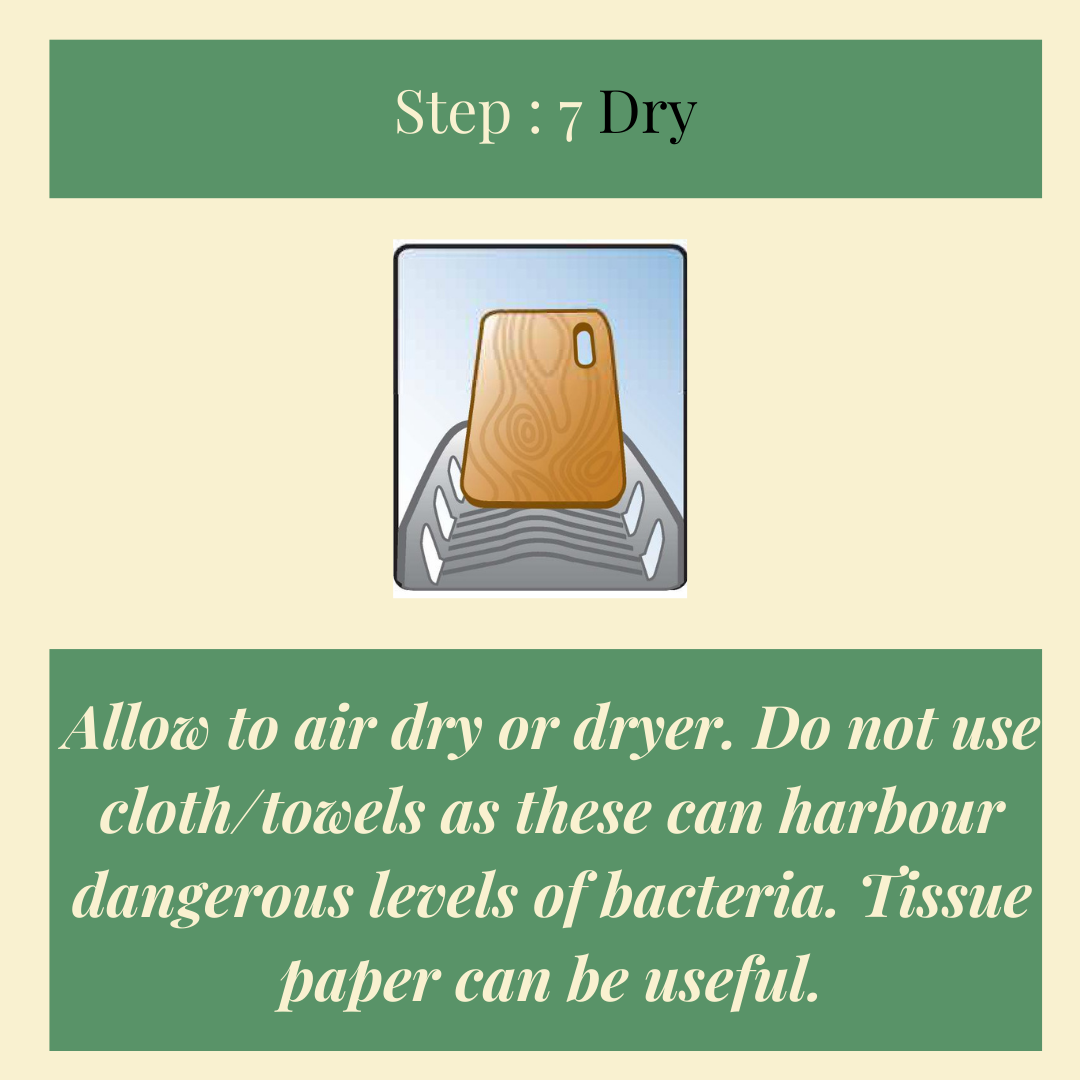

Allow to air dry or dryer. Do not use cloth/kitchen towel etc. as these can harbour dangerous levels of bacteria. Tissue paper can be useful.

Comments

Popular posts from this blog

FSSAI Has Changed The Logo For Non-Vegetarian Food 2021.

FSSAI Has Changed The Logo For Non-Vegetarian Food 2021.  

What is Food Safety Hazard,Types of Food Hazards & Prevention of Food Hazards 2020.

What is Food Safety Hazard, Types of Food Hazards & Prevention of Food Hazards 2020. Food Safety Hazard:- A food safety hazards refers to any agent with the potential to cause adverse health consequences for consumer. Food hazards may be physical, biological, chemical and allergic known as a food hazards. There are Four Type of Food Hazards: - 1)Physical Hazards 2)Chemical Hazards 3)Biological Hazards 4)Allergens. 1)Physical Hazards:- "Physical hazards includes foreign objects in food that can cause harm when eaten known as a physical hazards". Common Physical Hazards Include:- Glass or Metal Hair Finger nails. Jewelry piece. Lint & Threads Band-aids. Plastic or piece of disposable. Staples pins. Prevention of Physical Hazards:- Inspect raw material & equipment. Avoid jewelry, nail polishing, pinning(personal hygiene). By wearing proper attire. Avoiding use of stables. 2)Chemical Hazards:- "A chemical hazard is naturally  occurring and process induced chemica...

What is Food Frauds(Vulnerability Assessment & Critical Control Point),Types of Food Fraud, How Does Food Frauds Affect Consumers 2020.

What is Food Frauds(VACCP), Types of Food Fraud,  How Does Food Frauds Affect Consumers 2020. . A collective term used to encompass the deliberate and intentional substitution, addition, tempering or misrepresentation of food, food ingredients or food packaging or false or misleading statements made about a product, for economic gain . Food fraud for economic reasons is also increasing -requirement for a food fraud mitigation plan like melamine added to dairy products in china. VACCP PROCESS:- 1. Establish an  Vulnerability Assessment Team. 2.Use SSAFE's Food Fraud Vulnerability           Assessment Tools. Use Decision Tree to identify exposure to risk (ingredients, supplier, customers, product lines, brand, region, company-wide). Summaries information resulting from Decisions Tree analysis. Complete questionnaire to identify risk. Review main spider webs and certainty (opportunities/motivation and control). Review detailed spider web(opportunitie...