
What is the difference between chilling and freezing?

 What is the difference between chilling and freezing?


Chilling:

Chilling is a processing technique in which the temperature of a food is reduced and kept in temperature between -1 to 8 ℃.

Freezing:

A slow temperature drop occurs as ice crystals form within the food, freezing delays spoilage and keeps foods safe by preventing microorganisms from enzyme activity (-18℃).

Chilling:

Chilling simply means reducing the temperature at above freezing & below 15℃.


Freezing:

Freezing simply means cooling below it's freezing point.

Chilling:

It is used to reduce the rate of biochemical & microbiological changes hence to extend shelf life ( reduce growth but alive ).

Freezing:

Freezing causes death of 10% to 60% of the microbe population.

Chilling:

It causes minimal changes to sensory characteristics & nutritional properties of food.

Freezing:

It loss texture during freezing ice-crystals forms which cause adjacent cell walls to rupture, negligible chances to pigments flavor, & nutritionally important compounds very little nutrition loss most of the vitamin B & C is retained.
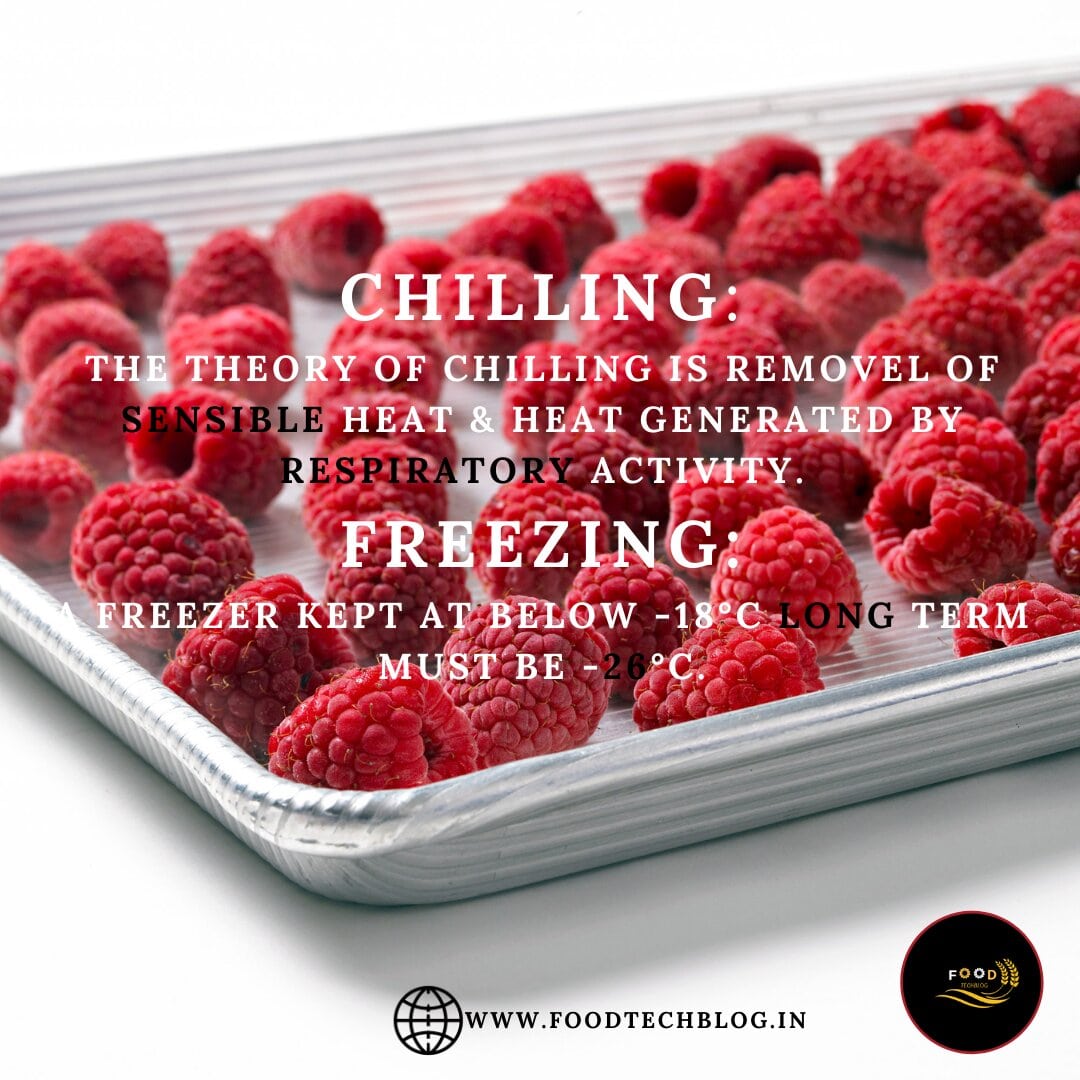
Chilling:

The theory of chilling is removal of sensible heat & heat generated by respiratory activity.

Freezing:

A freezing kept at below -18℃ & for long terms must be -26℃.

Chilling:

  • Shelf life short > 1 month.
  • Chilling is premium.
  • Chilling is for small proportion.

Freezing:

  • Longer >6 month.
  • Freezing is a affordable.
  • Freezing is for large proportion.


Comments

Popular posts from this blog

FSSAI Has Changed The Logo For Non-Vegetarian Food 2021.

FSSAI Has Changed The Logo For Non-Vegetarian Food 2021.  

What is Food Safety Hazard,Types of Food Hazards & Prevention of Food Hazards 2020.

What is Food Safety Hazard, Types of Food Hazards & Prevention of Food Hazards 2020. Food Safety Hazard:- A food safety hazards refers to any agent with the potential to cause adverse health consequences for consumer. Food hazards may be physical, biological, chemical and allergic known as a food hazards. There are Four Type of Food Hazards: - 1)Physical Hazards 2)Chemical Hazards 3)Biological Hazards 4)Allergens. 1)Physical Hazards:- "Physical hazards includes foreign objects in food that can cause harm when eaten known as a physical hazards". Common Physical Hazards Include:- Glass or Metal Hair Finger nails. Jewelry piece. Lint & Threads Band-aids. Plastic or piece of disposable. Staples pins. Prevention of Physical Hazards:- Inspect raw material & equipment. Avoid jewelry, nail polishing, pinning(personal hygiene). By wearing proper attire. Avoiding use of stables. 2)Chemical Hazards:- "A chemical hazard is naturally  occurring and process induced chemica...

What is Food Frauds(Vulnerability Assessment & Critical Control Point),Types of Food Fraud, How Does Food Frauds Affect Consumers 2020.

What is Food Frauds(VACCP), Types of Food Fraud,  How Does Food Frauds Affect Consumers 2020. . A collective term used to encompass the deliberate and intentional substitution, addition, tempering or misrepresentation of food, food ingredients or food packaging or false or misleading statements made about a product, for economic gain . Food fraud for economic reasons is also increasing -requirement for a food fraud mitigation plan like melamine added to dairy products in china. VACCP PROCESS:- 1. Establish an  Vulnerability Assessment Team. 2.Use SSAFE's Food Fraud Vulnerability           Assessment Tools. Use Decision Tree to identify exposure to risk (ingredients, supplier, customers, product lines, brand, region, company-wide). Summaries information resulting from Decisions Tree analysis. Complete questionnaire to identify risk. Review main spider webs and certainty (opportunities/motivation and control). Review detailed spider web(opportunitie...